
A quotation for fig powder is not comparable until you know whether it contains whole milled fruit, pulp powder, a carrier, added sugar or an instant beverage blend. By checking identity, process performance, documentation, storage needs and delivered cost, you can approve a material that works on your production line rather than choosing the cheapest listing.
Key takeaways
- Specify pure milled dried Ficus carica L., not pulp powder or sweetened mix.
- Set inclusion rates with application trials before approving a production formula.
- Check dispersion, flavour, moisture, and processing stability at pilot scale.
- Compare suppliers using delivered cost, documents, batch samples, and consistency.
Define the Fig Powder You Are Actually Buying
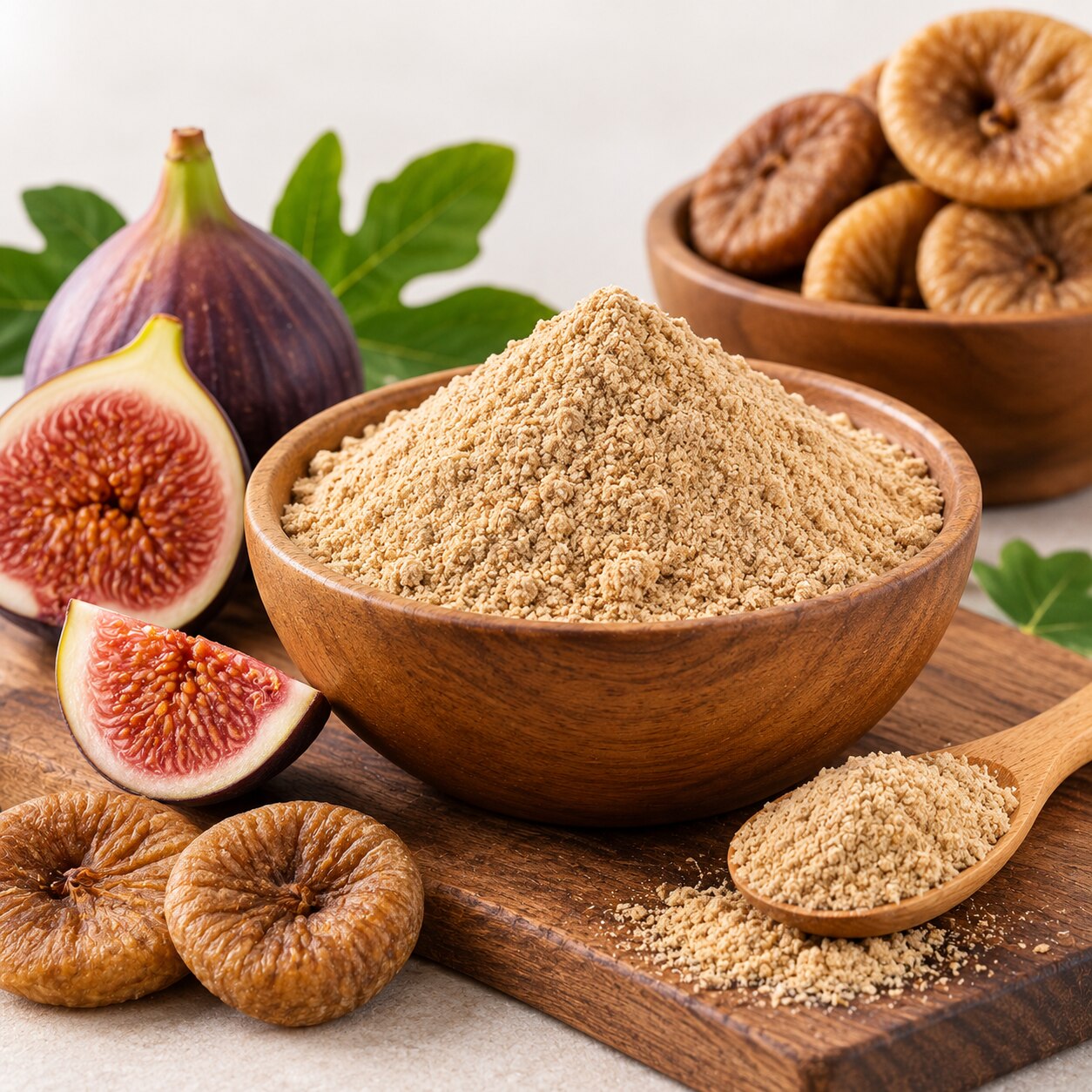
“Fig anjeer powder” can mean three different products: pure milled dried Ficus carica L., fig pulp or juice powder, or a sweetened beverage mix. Your purchase specification must name the product, because each behaves differently in formulation.
Require fruit-only composition unless you approve a named carrier in writing. Ask whether the source is whole figs, pulp or pieces, and whether seeds, peel and stems remain after processing. A search for a fig anjeer powder supplier in Pune is not enough; compare the specification, not the listing.
Request these fields before approving a sample:
- Country and season of origin
- Fruit-to-powder yield or concentration factor
- Sulphite treatment, including the residual limit
- Moisture and water activity limits
- Mesh range or particle-size distribution
- Bulk density
- Expected colour and flavour intensity
- Complete ingredient declaration covering maltodextrin, sugar, anti-caking agents, preservatives and other processing aids
“100% pure” proves little without evidence. Match the ingredient declaration to the product specification, retain a sealed sample, and require a lot-specific certificate of analysis (COA). Check that the COA identifies the same batch and reports appearance, odour, moisture, water activity, microbiology and foreign matter.
These records expose dilution, undeclared carriers and inconsistent fruit solids before they affect your recipe.
Set Starting Inclusion Rates by Application
Start with three pilot levels: low, middle and high within the relevant range. Approve a production rate only after comparing finished-product performance at all three levels.
- Bakery fillings: trial 3–8% of flour or filling mass.
- Biscuits: trial 2–5%.
- Nutrition bars: trial 5–12%.
- Shakes: trial 2–6%.
- Instant beverages: trial 1–4%.
- Dairy mixes: trial 1–5%.
- Dessert premixes: trial 3–10%.
- Nutraceutical powders or sachet blends: trial 1–3%.
These are pilot targets, not universal formulas. The correct rate depends on sweetness, moisture, particle size, fruit intensity, carrier content and the nutrition panel you must achieve.
At each level, check hydration time, sweetness, texture, colour and fruit aroma. For liquid products, record dispersibility, sedimentation and viscosity; for dry products, measure blend uniformity, flow and caking. Confirm capsule or sachet fill weight where applicable, because bulk density can change the delivered dose even when the percentage is unchanged.
Run accelerated and real-time shelf-life checks on the finished product, including moisture migration, flavour loss, colour change, microbial stability and pack performance. A powder that works on day one can cake or separate later.
For nutraceutical products, review FSSAI rules for the ingredient, product format, labelling and claims before launch. Ordinary fig powder does not support claims that the product treats diabetes, constipation, anaemia or another disease.
Check Processing Performance Before Full-Scale Production
Approve a fig powder only after its process behaviour is documented, not because the supplier calls its drying “advanced.” Request the named method: spray-dried, tray-dried, drum-dried, freeze-dried, or another specific process.
| Drying method | Main performance trade-off |
|---|---|
| Spray-dried | Usually disperses readily; check carrier use, flavour dilution and heat exposure |
| Tray-dried | Can retain dense fruit flavour; inspect colour variation, hard particles and rehydration |
| Drum-dried | Receives direct heated-surface exposure; test cooked notes, darkening and dispersibility |
| Freeze-dried | Offers strong flavour and colour retention; check fragile structure, cost and moisture pickup |
Obtain representative-lot results for moisture, water activity, particle-size distribution or sieve range, bulk density, solubility or dispersibility, expected colour, odour and flavour intensity. Ask for real-time or accelerated shelf-life evidence with storage temperature, humidity and packaging stated.
The Codex maximum moisture level of 24% applies to dried figs, not automatically to milled powder. Set a separate powder moisture limit and water-activity limit because milling increases surface area, caking risk and moisture pickup.
Control the line as follows:
- Weigh quickly in low-humidity conditions.
- Break lumps through the specified sieve.
- Preblend the powder with part of the dry carrier.
- Add it gradually during hydration.
- Use sealed moisture-barrier packs and reseal opened packs.
Run a process-specific trial for baking, pasteurisation, spray mixing or another heat treatment. Do not assume a powder that disperses in water will retain colour, flavour or flow after heating.
Qualify the Pune Supplier With Documents and Samples
A real manufacturer can show where and how the powder is made. Ask for the manufacturing-site address, applicable food licence, process-flow diagram, and records proving control of cleaning, drying, milling, sieving, metal detection and packing.
Search results for anjeer powder manufacturer India do not prove local production. Compare the locations directly:
| Location | What it proves | What it does not prove |
|---|---|---|
| Manufacturing site | Where processing and packing occur | That every lot is made there |
| Pune warehouse | Where stock is stored or dispatched | That Pune is the manufacturing location |
| Trading office | Where orders and documents are managed | That the business controls production |
A bulk fig powder supplier in Pune should provide a COA matched to each proposed lot. Check appearance, odour, moisture, water activity, total plate count, yeast and mould, specified pathogens and foreign-matter status.
For supplement, infant, clinical or export use, add heavy metals, pesticide residues, aflatoxins or other mycotoxins, allergen status, and identity or authenticity testing.
Reconcile the lot or batch number, net quantity, date marking, ingredient declaration, business details and licence information across the pack, specification and COA. Ask for a retained sample and traceability record, then audit the site if the volume or risk justifies it.
Prime Herbonix Health Products Private belongs on the comparison list only after supplying the same manufacturing, specification and lot-level evidence.
Related product
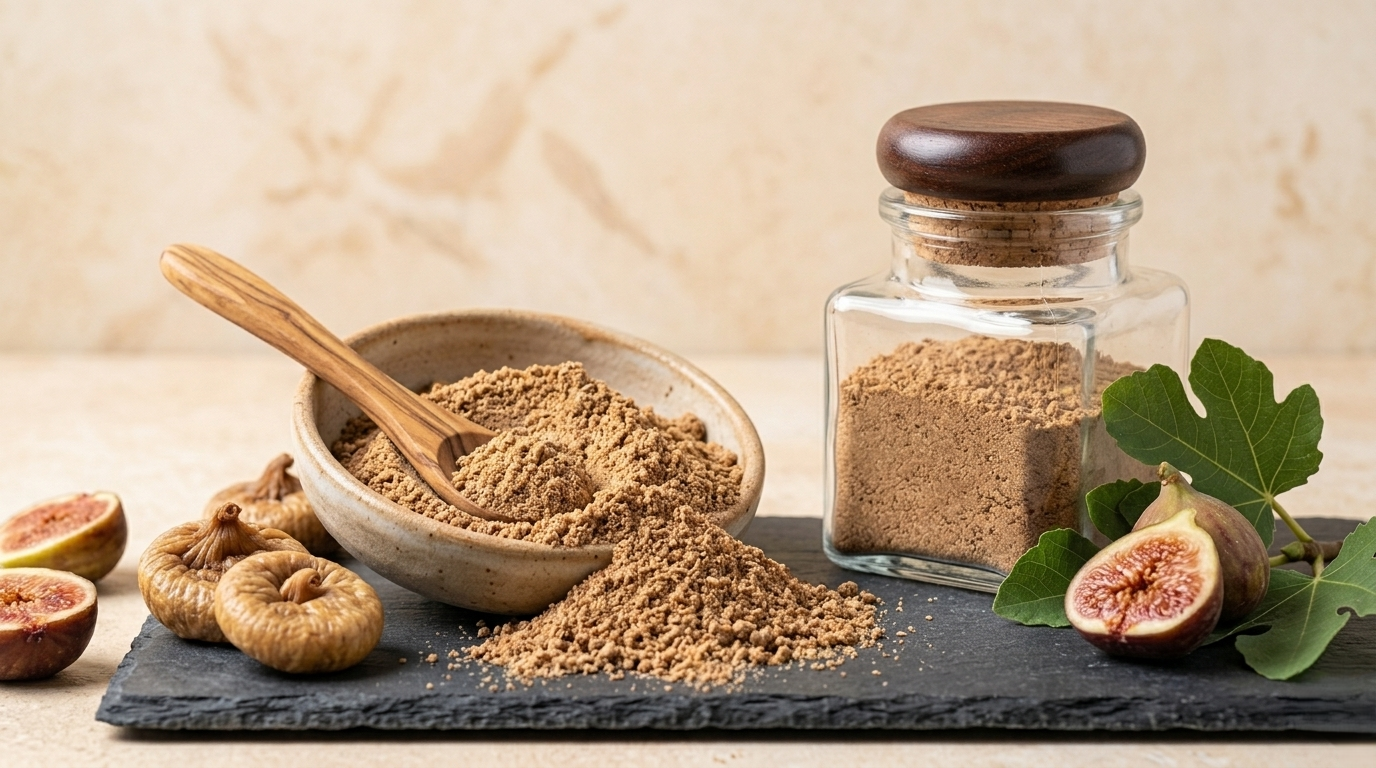 | FRUIT POWDERS 🌰 FIG (ANJEER) POWDER Fig (Anjeer) Powder is made from carefully selected premium-quality figs that are processed using advanced drying and milling... View product → |
Compare Fig Powder Price in Pune on a Delivered-Cost Basis
Fig powder price in Pune differs because “fig powder” can mean whole-fruit powder, extract, or pulp powder, with or without a carrier.
| Quote basis | What changes the quote | What to compare |
|---|---|---|
| Whole-fruit powder | Fruit yield, mesh size, organic certification, carrier use | Ficus carica L. identity, moisture, mesh and carrier declaration |
| Extract or pulp powder | Solids concentration and flavour strength | Equivalent flavour or solids contribution per finished-product batch |
| Commercial offer | Minimum order quantity, testing package and packaging | Ex-works, delivered and GST-inclusive prices |
Ask every supplier to quote the same specification, pack size, Pune delivery point, lead time and payment terms. Ex-works excludes freight; delivered pricing includes transport to the named point; GST-inclusive pricing includes the stated tax.
Calculate usable cost per kilogram as invoice cost divided by kilograms accepted after moisture adjustment, rejected material and sieving loss. Then compare the quantity needed to deliver the same flavour or solids contribution. Include moisture-barrier packaging, disposal of liners, and labour or materials for resealing opened packs.
Check shelf life against real-time or accelerated stability data, storage temperature and humidity instructions. Hygroscopic fig powder can cake and lose performance after opening.
Approve the lowest total-cost option only after:
- A representative line trial
- COA review, including laboratory methods
- Reconciliation of the ingredient declaration with the specification and retained sample
Frequently asked questions
What type of fig anjeer powder should you buy?
Name the product in the specification: pure milled dried Ficus carica L., fig pulp or juice powder, or a sweetened beverage mix.
How do you set a starting inclusion rate for fig powder?
Set a trial inclusion rate for the specific application, then adjust it after checking flavour, texture, colour, sweetness, and processing performance.
What should you test before full-scale fig powder production?
Run a pilot batch and check dispersion, hydration, flavour, colour, texture, flow, and stability through the planned process.
How should you compare fig powder suppliers in Pune?
Request documents and production samples, then compare the delivered cost rather than comparing the quoted powder price alone.