
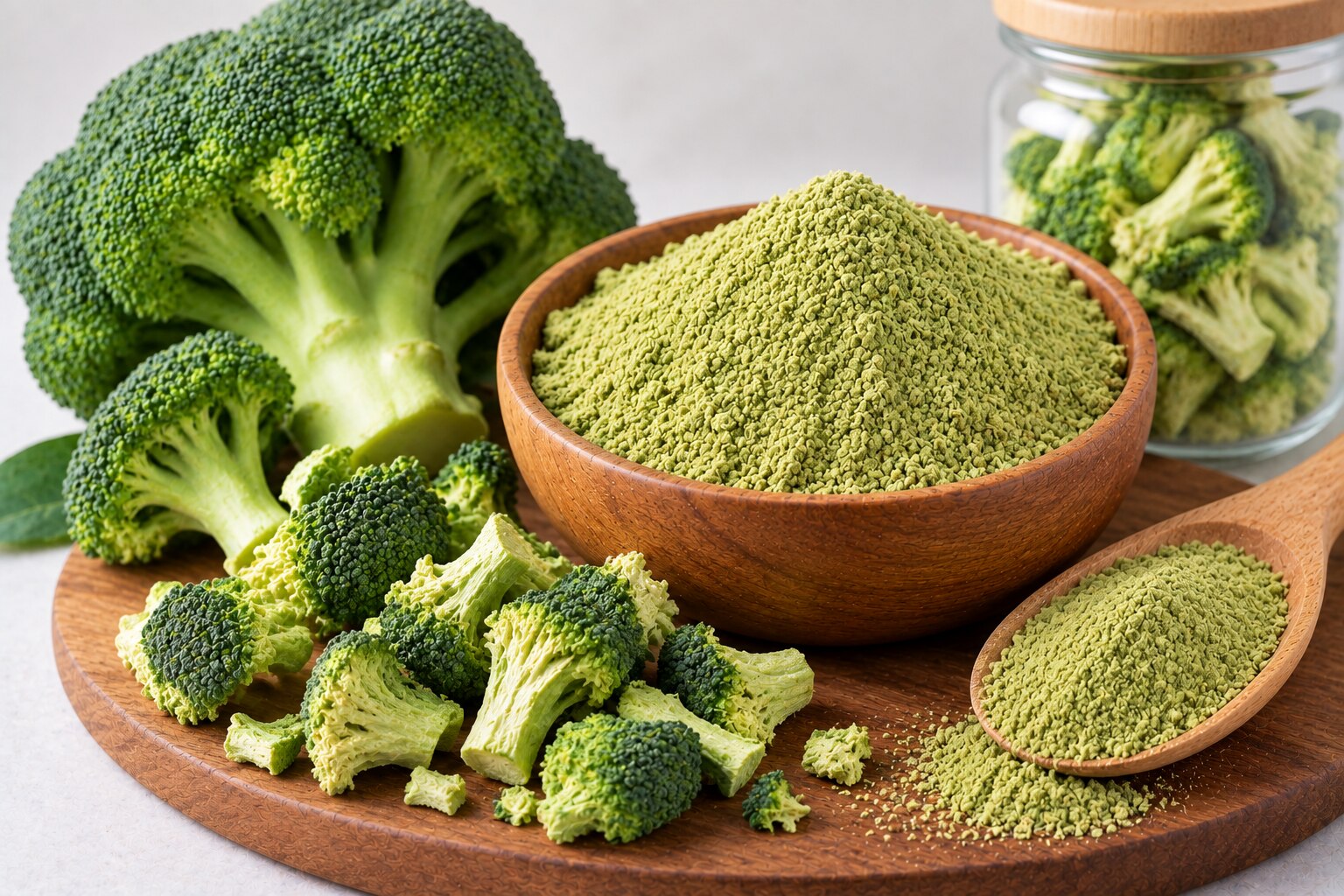
Choosing a broccoli ingredient involves more than comparing nutrient claims: drying method, particle size, sensory impact, assay data and moisture control all affect the finished product. By the end, you can select the right format, set a defensible trial level, calculate batch requirements and qualify a supplier for food or nutrition manufacture.
Key takeaways
- Use freeze-dried broccoli when lower heat exposure supports colour and flavour retention.
- Match pieces, granules or powder to particle size, texture and dispersion requirements.
- Calculate trial quantities from inclusion rate, batch size and ingredient moisture.
- Request identity, assay, moisture, water activity and application data from Pune suppliers.
What freeze-dried broccoli changes compared with other drying methods
Freeze-drying removes water from frozen broccoli by sublimation, keeping the product temperature lower than in hot-air dehydration or drum drying. That reduced heat load can better retain green colour, fresh flavour and heat-sensitive nutrients, but it does not guarantee preservation of every bioactive compound.
| Method | Resulting ingredient | Main formulation distinction |
|---|---|---|
| Freeze-drying | Whole-vegetable pieces, granules or powder | Low-temperature water removal; better retention of heat-sensitive qualities |
| Hot-air dehydration | Thermally dried vegetable | More heat exposure; colour, flavour and nutrient losses can increase |
| Drum drying | Sheet or powder made on a heated drum | Strong thermal treatment and possible cooked notes |
| Spray drying | Extract or liquid feed dried into particles | Often carrier-based; not equivalent to whole broccoli powder |
A spray-dried broccoli extract can therefore deliver a different composition from a vegetable powder, especially when maltodextrin or another carrier is present. Freeze-dried material is not automatically the best route for sulforaphane: heat can inactivate myrosinase while glucoraphanin remains, and sulforaphane forms only when myrosinase converts it.
Ask for the measured target: total glucosinolates, glucoraphanin, active myrosinase, or sulforaphane after a defined conversion assay. A search for freeze dried for broccoli benefits in pune should end with that specification, not a generic antioxidant claim.
For a nutrition claim, also check native moisture, ash, protein and serving size; removing water concentrates existing solids but creates no new nutrients.
Choose pieces, granules or powder for the product’s physical demands
Pieces suit visible inclusions, soups and textured instant meals; granules preserve vegetable identity while improving flow and reducing dusting; fine powder suits blended products.
| Format | Best fit | Main physical risk |
|---|---|---|
| Pieces | Visible inclusions, soups, textured instant meals | Sedimentation, uneven distribution or unwanted green specks |
| Granules | Seasoning blends and products needing visible identity with better handling | Variable flow and incomplete dispersion |
| Fine powder | Soups, savoury premixes, sauces, bakery mixes and snack coatings | Caking, dusting and poor dispersion when particles are too fine |
For broccoli powder for food products, request particle-size distribution by sieve analysis or laser diffraction before approving a lot. Coarse material can settle or leave green specks, while very fine material can cake, dust and disperse poorly.
Fine powder also works as broccoli powder for nutrition products in blends, capsules and sachets. Test capsule fill weight, powder flow, dose uniformity and sachet filling performance; inclusion rate alone cannot support a nutrition claim.
Freeze-dried broccoli is the wrong starting choice for a clear beverage, completely smooth emulsion or rapid-reconstitution product until wetting, shear, particle-size distribution and insoluble-fibre behaviour pass trials. A porous powder can float, form lumps or leave sediment instead of producing a smooth drink.
Run sensory trials at the intended use level. Measure green colour, vegetable aroma, sulphurous notes, bitterness, mouthfeel and consumer acceptance; a dry-powder taste test will not predict performance after hydration or cooking.
Set a trial inclusion level and calculate the real batch requirement
Start with a bench level, then convert that percentage into the quantity your process will actually consume.
1. Choose a starting point based on the application: 1–5% for soups and savoury premixes; 0.5–2% for bakery mixes and snack seasonings; or 0.5–2% for beverage and nutrition blends where flavour permits. For broccoli powder for nutrition products, test roughly 250 mg–2 g per serving before label, sensory and safety review.
2. Calculate the theoretical requirement. A 100 kg batch at 2% needs 2 kg of powder.
3. Adjust for process loss or expected yield. If the process is expected to retain 97% of the ingredient, divide 2 kg by 0.97: purchase or stage about 2.06 kg. Use your measured yield rather than adding an arbitrary allowance.
4. Estimate fresh-broccoli equivalence from the supplier’s actual batch data. If the powder recovery ratio is 8%, divide the required 2 kg of powder by 0.08 to estimate 25 kg of fresh broccoli. Do not assume a fixed fresh-to-powder ratio; cultivar, plant part, moisture and processing change recovery.
5. Confirm the final level against flavour, green colour, moisture, texture, dispersion and nutrition targets. Higher inclusion can intensify sulphurous notes, bitterness and mouthfeel.
Inclusion rate alone cannot support a nutrition claim. Use native moisture, ash, protein, serving size and a marker-compound assay for the claim calculation.
Control moisture, water activity and packaging from receipt to use
Protect the powder by treating moisture control as a release and handling requirement, not a warehouse preference. Its porous, hygroscopic structure pulls water from humid air, causing clumping, poor flow, dusting changes and faster colour, flavour and nutrient deterioration.
1. Request a lot-specific certificate of analysis before release. It should state moisture or loss on drying, water activity, particle-size distribution by sieve or laser diffraction, colour, microbial counts and pathogen results, pesticide compliance, heavy-metal results, foreign-matter controls, test methods and lot identification.
2. Check the pack type and barrier performance against the supplier’s specification. Ask for the required seal, unopened storage temperature and relative-humidity limits, shelf life, and permitted post-opening use period; do not substitute assumed values.
3. Keep unopened packs sealed until production. After opening, use a clean, completely dry scoop, minimise open-room exposure, and reseal the pack immediately. Do not leave powder in a hopper, weighing container or loosely folded liner.
4. Control warehouse temperature and relative humidity within the supplier’s stated limits. Warm, humid air drives moisture into the powder; repeated exposure turns free-flowing material into lumps and can accelerate microbial or chemical deterioration.
5. Confirm that freeze-drying has not been treated as sterilisation. Raw-material counts, pathogen testing, post-drying environmental controls, foreign-matter checks and packaging integrity remain necessary for food and supplement use.
Reject a lot or pause production when the seal is damaged, the powder is visibly wet or caked, or its certificate lacks a defined test result.
Qualify a Pune supplier with identity, assay and application evidence
Approve a lot only after separating identity evidence from manufacturing suitability. A botanical name, plant part and botanical or DNA identity test confirm that the material is broccoli; they do not prove that it will perform in your product.
- Ask the freeze dried broccoli supplier in Pune for a lot-specific certificate of analysis. Require the lot number, sampling date, test method and result for moisture or loss on drying, water activity, microbial counts, pesticides, heavy metals, particle-size distribution, colour and foreign matter.
- Define the marker before comparing samples. Ask whether the report measures glucoraphanin, total glucosinolates, active myrosinase, or sulforaphane after a stated conversion assay. Glucoraphanin alone is not equivalent to a standardized sulforaphane ingredient.
- Request application samples in the intended format. Test wetting, dispersion, sedimentation, flow, colour, vegetable aroma, sulphurous notes, bitterness and mouthfeel in the finished food, capsule or sachet.
- Confirm the regulatory route. Identify the applicable FSSAI food category, or use the separate framework for nutraceutical and health-supplement products, before approving claims or labels.
The phrase “freeze dried for broccoli benefits in Pune” describes a search, not a nutritional advantage. Cultivar, plant part, pre-treatment, drying cycle, milling, packaging, humidity and assay results matter more than location; Pune mainly helps procurement and logistics.
Prime Herbonix Health Products Private belongs on the comparison list only after documented samples, application trials and specification review—not on a generic “broccoli powder” claim.
Related products
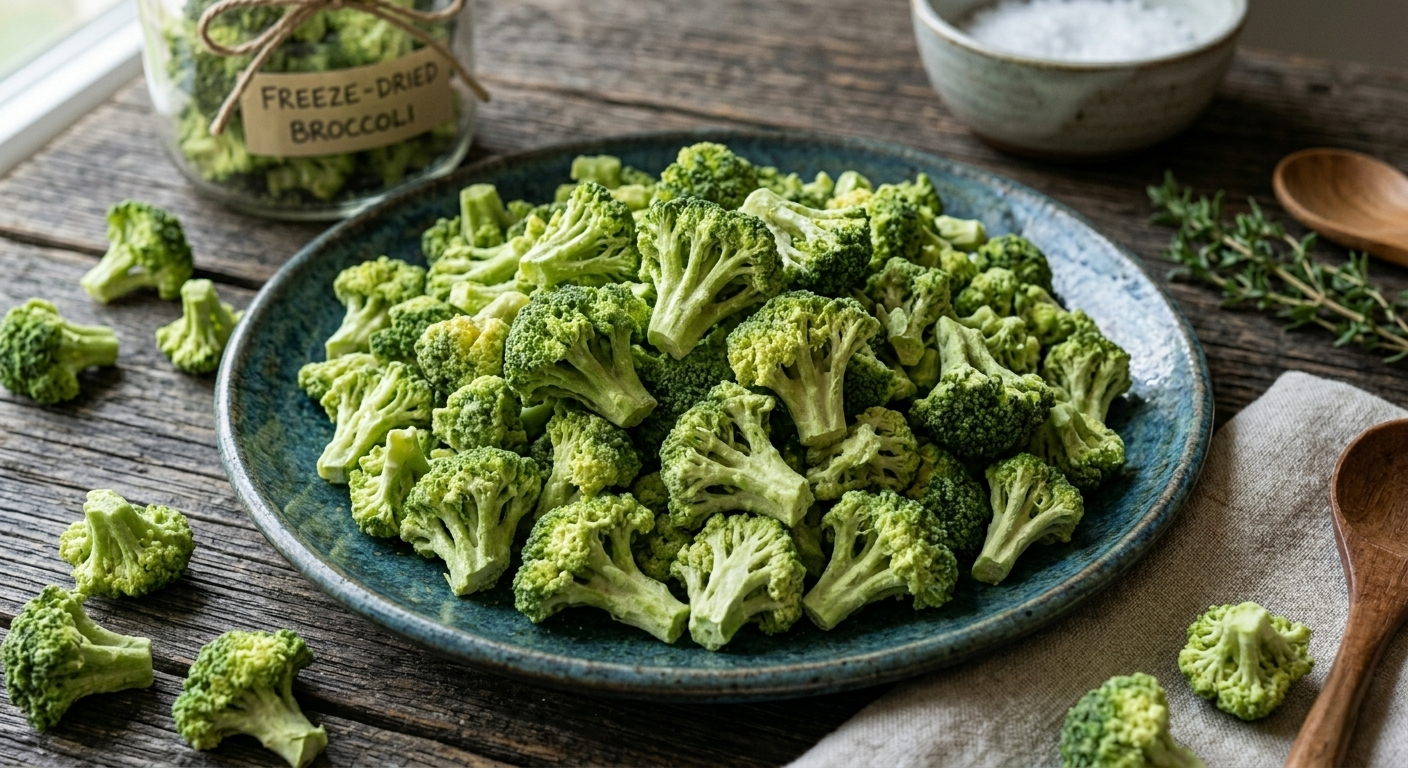 | FREEZE-DRIED VEGETABLE & FRUIT POWDERS /SLICES /CHUNKS 🥦 Prime Herbonix Freeze-Dried Broccoli is produced from carefully selected fresh broccoli florets using advanced freeze-drying technology that helps... View product → |
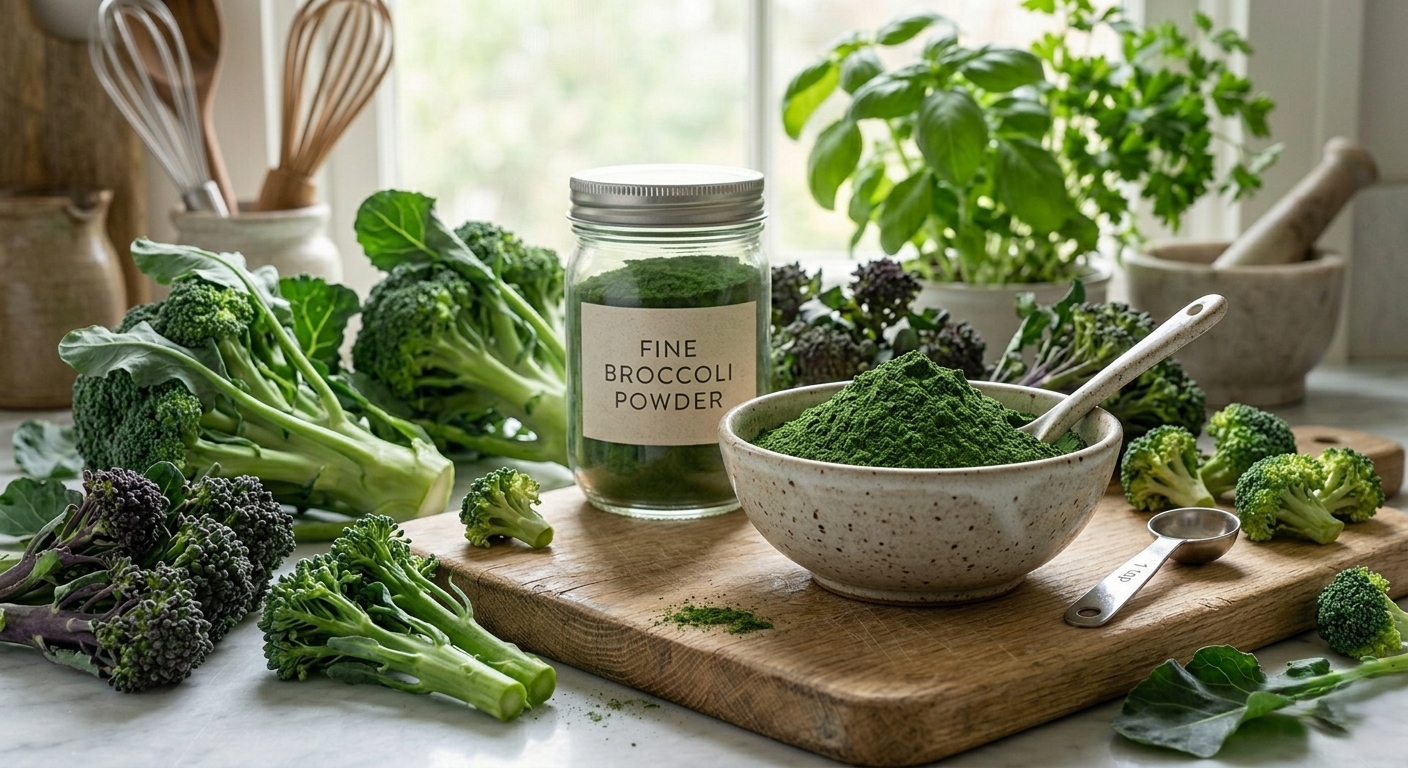 | VEGETABLE, HERBS & SEEDS POWDERS / FLAKES / GRANULES 🥦 Prime Herbonix Broccoli Powder is produced from carefully selected fresh broccoli that is gently dehydrated and finely milled to preserve its... View product → |
Frequently asked questions
How does freeze-dried broccoli differ from hot-air or drum-dried broccoli?
Freeze-drying removes ice by sublimation at a lower product temperature, which can better retain green colour, fresh flavour and heat-sensitive nutrients. It does not preserve every bioactive compound automatically.
Should you choose broccoli pieces, granules or powder?
Choose pieces for visible inclusions, granules for controlled texture and easier handling, and powder for uniform distribution in beverages, bakery mixes, supplements and other nutrition products.
How do you calculate the broccoli needed for a formulation trial?
Multiply the finished batch size by the target inclusion percentage, then account for the ingredient's moisture, processing loss and the number of trial batches required.
What should you check when qualifying a freeze-dried broccoli supplier in Pune?
Request identity documentation, an assay or nutrient specification, moisture and water activity results, batch traceability, packaging details and application samples using broccoli powder for food or nutrition products.