
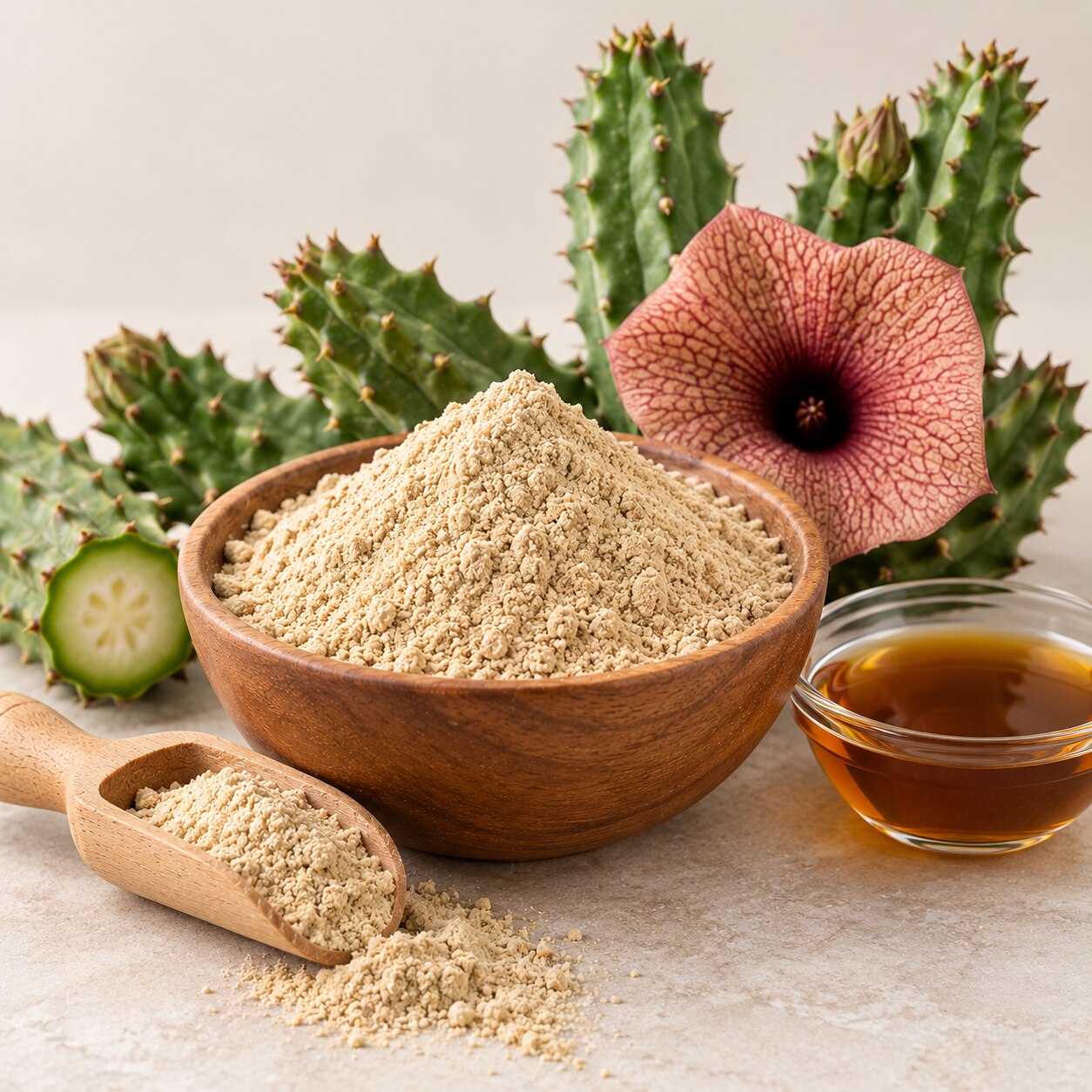
The choice between whole Hoodia powder and a concentrated extract affects dose volume, flavour, processing, documentation, and the claims your finished supplement can support. By the end, you can compare both forms, write a receiving specification, screen authenticity and safety, and decide what to request from a Pune supplier before approving a private-label formula.
Key takeaways
- Choose whole powder when the serving fits your capsule or sachet fill weight.
- Specify plant part, extract ratio, marker assay, solvents, and test methods.
- Request identity testing, batch records, contaminants reports, and an adulteration screen.
- Treat appetite, weight-loss, and safety claims as a regulatory review issue.
When does whole Hoodia powder make more sense than an extract?
Whole Hoodia powder makes more sense when the serving fits a practical fill weight and your label permits the complete milled plant material. It suits capsules, tablets, simple sachets, and meal-replacement powders better than low-mass formats.
| Option | Main effect | Best fit |
|---|---|---|
| Whole powder | More plant solids, fibre-like matter, colour, odour, and batch variability | Capsules, tablets, sachets |
| Extract | Smaller serving and easier marker specification | Low-fill capsules and defined-dose blends |
Whole powder is a poor choice for clear beverages, small gummies, and low-mass blends. A large inclusion can cause sediment, bitterness, dark colour, or an unpleasant mouthfeel.
An extract reduces serving size, but a 10:1 ratio only means ten parts starting material produced one part extract. It does not prove P57 content or equivalence to a clinical preparation. Require a chromatographic fingerprint and quantitative assay.
Compare cost per finished serving, not cost per kilogram. Multiply the ingredient price by the actual serving weight, then add carriers, overages, encapsulation limits, process losses, and rejected batches.
Before comparing a hoodia powder supplier in Pune or a hoodia powder bulk supplier, ask for:
- Plant part and species
- Native-to-extract ratio, solvent, and extraction temperature
- Carrier percentage and drying method
- Declared marker assay and test method
If the powder’s lower price disappears after this calculation, choose the extract.
What extract specification should appear in the formulation brief?
A 10:1 or 20:1 ratio is not an active-dose claim. It only describes the nominal amount of starting plant used to produce one part of extract, so your brief must define the chemistry separately.
1. Identify Hoodia gordonii and the authenticated plant part, then record the native-to-extract ratio, extraction solvent, actual extraction temperature range in °C, concentration step, and drying process: spray-drying, freeze-drying, or another named method.
2. State every carrier or excipient, including maltodextrin or gum, with its percentage. Carrier content changes active-material calculation, bulk density, flow, and the label declaration.
3. Name the marker target and acceptance range. For P57, require chromatographic identity plus a quantitative HPLC or LC-MS method reporting percentage or milligrams per gram. The supplier must demonstrate specificity, precision, linearity, and recovery in its matrix.
4. Set the serving only after reviewing the assay. Specify extract mass per serving, maximum inclusion, marker amount per serving, and equivalent raw-powder quantity. If a hoodia extract supplier India cannot disclose these figures, classify the material as chemically undefined.
This brief gives a hoodia ingredient for supplements a purchasing, testing, and batch-release standard; “contains bioactive compounds” does not. Ask for the complete specification before comparing quotations.
How will powder or extract behave in capsules, gummies, and drinks?
Choose powder for hard capsules, tablets, meal-replacement powders, and dry sachets when its serving volume, bulk density, moisture, and flow match your equipment. Choose extract when a capsule needs less fill or the brief requires a defined marker.
| Format | Powder | Extract |
|---|---|---|
| Hard capsules | Works when the dose fits the shell and flows into it | Reduces fill volume and supports marker-based specifications |
| Gummies | Plant solids can add bitterness, odour, green-to-brown colour, and gritty texture | Smaller mass helps, but bitterness and colour can remain |
| Drinks | Poor dispersibility, sediment, and visible colour can persist after sweetening | May disperse more easily, but does not guarantee clarity or neutral taste |
Do not select either form for a gummy or beverage just because the dose is small. Check hygroscopicity, water activity or moisture, particle size, and flow, then run trials with the actual sweetener, flavour, binder, acidulant, emulsifier, and beverage system. Record dispersion time, sediment after 30 minutes, pH drift, and taste after processing.
Review blend temperature and hold time for heat-sensitive constituents, and test short-term stability at the formula’s pH and packaging humidity. A hoodia ingredient for supplements remains a formulation input; evaluate the final serving after encapsulation, compression, blending, or reconstitution.
What claims and safety review can a Hoodia supplement support?
Do not label Hoodia as a proven appetite suppressant or promise clinically meaningful weight loss. Traditional-use wording does not prove appetite reduction, weight loss, or clinical efficacy. In a randomized, double-blind, placebo-controlled trial, 49 overweight women received standardized Hoodia gordonii extract or placebo for 15 days; the extract produced no significant appetite-suppressing or weight-loss benefit.
Reported adverse changes included nausea, vomiting, skin sensations, elevated blood pressure, and increased heart rate.
1. Request human evidence for the exact extract, not for the Hoodia name alone. Do not claim equivalence to a pharmaceutical appetite suppressant or to a clinical preparation without product-specific, compliant evidence.
2. Obtain a safety dossier identifying species, plant part, extract ratio, solvent, marker level, serving size, and product format. Review adverse effects, pregnancy and lactation restrictions, cardiovascular conditions, diabetes, liver or kidney disease, and interactions with medicines affecting blood pressure, heart rate, glucose, or appetite.
3. Have a qualified regulatory and medical reviewer approve claims and warnings. Check the current FSSAI category and permitted-ingredient position before approving manufacture in India; an overseas supplier’s sale does not establish Indian market permission.
Dose, extraction process, claims, and format can change the conclusion. Final label language must follow the evidence and the applicable Indian framework.
How do you authenticate Hoodia and control adulteration before release?
Release only when the lot’s identity is proven by more than its appearance or a supplier label. Require Hoodia gordonii, the plant part, voucher-backed botanical identification, and a validated receiving identity test. A hoodia powder bulk supplier should provide a certificate of analysis naming the method and acceptance criterion, not merely “Hoodia extract.”
| Form | Identity and composition evidence | Release controls |
|---|---|---|
| Raw powder | Microscopy or DNA barcoding screens substitution; HPLC or LC-MS fingerprinting confirms the chemical profile | Identity, moisture, foreign matter, microbial limits, pesticides, heavy metals, and aflatoxins where relevant |
| Extract | DNA can be degraded or absent and cannot quantify P57; chromatography plus a quantitative P57 assay is required | Solvent residues, carrier or excipient percentage, extract ratio, marker result, and drying method |
- Verify HPLC or LC-MS specificity, precision, linearity, and recovery for the actual matrix. DNA and microscopy complement, but do not replace, potency testing.
- Test independent pre-shipment samples and repeat identity, fingerprint, marker, and adulterant testing on periodic production lots. The commercial value of “Hoodia” creates a substitution incentive.
- For imported Hoodia, retain the CITES Appendix II permit trail covering exact species, quantity, and shipment. Test finished slimming products for undeclared pharmaceutical weight-loss drugs or stimulants.
What should you ask a Pune supplier before placing a private-label order?
Approve a Pune partner only after identity, potency, contaminants, stability, claims, and FSSAI status align. Ask a hoodia powder or extract supplier in Pune for:
- A current batch COA, representative sample, full specification, manufacturing-site quality evidence, batch traceability record, and change-control procedure.
- Allergen and GMO statements where relevant, contaminant reports, and stability data in the proposed packaging.
- For imports, source-country CITES documentation matching the invoice, species, quantity, and shipment. Ask each hoodia extract supplier India team to disclose the drying method, solvent residues, carriers, extract ratio, and marker assay.
| Option | Confirm before approval | Compare |
|---|---|---|
| Whole powder | Moisture, identity, microbes, pesticides, heavy metals, foreign matter | Price per kilogram and finished serving |
| Extract | Spray-dried, freeze-dried, or other process; carrier percentage and quantitative P57 method | Price per declared marker dose |
| Either | Sample performance and batch consistency | Price per finished serving after excipients and process losses |
Prime Herbonix Health Products Private becomes useful when it turns these documents into a repeatable specification for capsules, sachets, beverages, or meal replacements and supports formulation trials. “Food grade” alone proves nothing about nutraceutical suitability. Reject the SKU if traceability, independent testing, stability, or regulatory justification is missing.
Related product
 | HERBAL POWDERS & EXTRACTS Prime Herbonix Hoodia Powder & Extract are derived from carefully selected *Hoodia gordonii* plant material and processed under stringent quality... View product → |
Frequently asked questions
When does whole Hoodia powder make more sense than an extract?
Choose whole powder when the serving fits a practical fill weight and your label permits milled plant material. It suits capsules, tablets, sachets, and meal-replacement powders better than low-mass formats.
What extract specification should appear in a formulation brief?
State the Hoodia species and plant part, extraction ratio, extraction solvent, carrier, marker compound or assay, moisture limit, microbiological limits, heavy-metal limits, pesticide requirements, and identity test.
How will Hoodia powder or extract behave in capsules, gummies, and drinks?
Powder adds more mass and can affect flow, capsule fill, mouthfeel, and sedimentation. Extracts reduce dose volume but can intensify bitterness, require a carrier, and need dispersion testing in gummies and beverages.
What claims and safety review can a Hoodia supplement support?
Do not assume Hoodia supports appetite or weight-loss claims. Review the target market's permitted claims, evidence, novel-food or ingredient rules, contraindications, medication interactions, maximum serving, and adverse-event process before approval.
How do you authenticate Hoodia and control adulteration before release?
Confirm species and plant part with authenticated reference material and a validated identity method such as DNA testing or botanical microscopy. Compare the certificate of analysis with independent testing for assay, contaminants, pesticides, microbes, and undeclared pharmaceuticals.