
Choosing a carrot ingredient involves more than comparing prices per kilogram. You need to match the format to the finished product, set measurable quality and rehydration requirements, and test how the ingredient behaves in your process before approving a supplier.
Key takeaways
- Use powder for uniform blends; choose flakes for visible pieces and rehydrated texture.
- Test inclusion and rehydration in the finished recipe, not only in water.
- Specify moisture, particle size, microbiology, packaging, and traceability before buying.
- Compare landed cost, storage needs, and shelf life before choosing freeze-dried carrot.
Choose the carrot format that matches your finished product
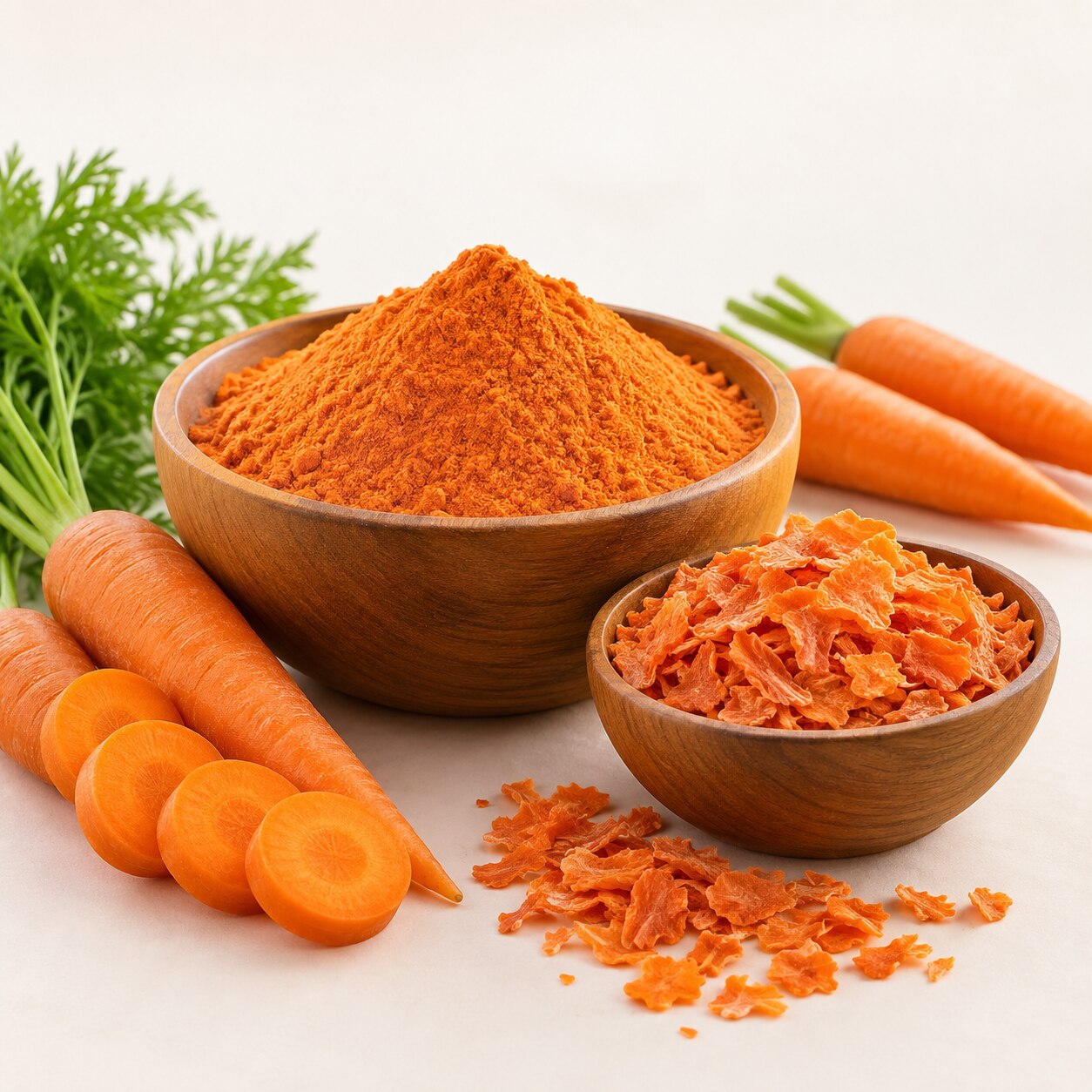
Fine powder is the best choice when carrot must distribute evenly through seasoning blends, soups, sauces, bakery premixes, pasta, nutrition powders, or dry beverage systems. Flakes and slices suit products requiring visible vegetable pieces, chew, or rehydrated texture.
| Format | Best use | Purchasing checks |
|---|---|---|
| Fine powder | Uniform blending and smooth systems | Mesh pass rate, dusting, caking, dispersibility |
| Coarse powder | Visible vegetable character with less dust | Particle-size range, flow, sediment |
| Granules | Controlled visible pieces in dry mixes | Granule dimensions, breakage, fines |
| Flakes | Soups, fillings, snacks, and rehydrated foods | Length, width, thickness, fines, breakage |
| Slices | Larger visible pieces and premium texture | Diameter, thickness, rehydration time, colour retention |
Granules and coarse powder reduce some dusting and caking compared with very fine powder, but they will not produce a completely smooth sauce or beverage. Specify dimensions, thickness, percentage of fines, and breakage rate before you buy carrot powder and flakes in Pune.
For carrot ingredients for food manufacturers, distinguish whole-carrot powder from spray-dried carrot juice powder, carrot extract, and products containing maltodextrin or starch. Your specification must state raw-material identity, whole-carrot or juice-derived status, peel inclusion, blanching treatment, and drying method; “100% carrot” alone is insufficient.
Set a starting inclusion rate and test rehydration in the real recipe
Start with these pilot levels for carrot ingredients for food manufacturers:
1. Use 1–5% powder in savoury blends, soups, sauces, bakery premixes, pasta and snack seasonings. That equals 10–50 g per kg of finished formulation. Use 2–8% flakes, or 20–80 g per kg, when visible pieces are required. Start below these levels in beverage powders until you check sediment, sweetness, vegetable flavour and mouthfeel.
These are trial starting points, not universal formulation limits.
2. Run bench trials at the intended batch size. Increase the addition for stronger orange colour or vegetable flavour; reduce it when sweetness, added solids, viscosity or water binding becomes excessive. Recheck final water activity after adjusting water, because carrot solids can change moisture distribution and shelf stability.
3. Disperse powder directly into the dry ingredients, then test the recipe. If lumps form, pre-slurry the powder in part of the recipe water before combining it with the batch.
4. For flakes, begin with about 3:1 water to flakes by weight and soak for 10–20 minutes. Assess the texture before deciding whether cooking is needed; set the final ratio from the supplier’s rehydration data. Record recovered weight, texture, sediment and colour after rehydration.
Write a purchase specification that quality control can actually release
Set a release specification before asking a carrot powder supplier in pune for a bulk quotation. Use the same document to compare every dehydrated carrot powder supplier.
1. Identify the material as whole-carrot or juice-derived, with peel inclusion or exclusion, blanching treatment, drying method, and pack format. Set moisture at the buyer’s starting target of 5–8% and require a batch water-activity result; moisture alone cannot predict caking, mould risk, or shelf stability.
2. For powder, state the sieve or particle-size distribution, such as minimum percentage passing a named mesh. Add bulk density, flowability, dispersibility, odour, colour, and foreign-matter limits. For flakes, specify length, width, thickness, fines, broken pieces, rehydration time, rehydrated texture, and colour retention. Require colour as CIELAB L*, a*, b* values, not “vibrant orange.”
3. For nutraceutical or functional-nutrition use, request total carotenoid or beta-carotene assay, analytical method, and batch result. Natural colour does not prove potency. Require total aerobic count, yeast and mould, Enterobacteriaceae or coliforms, Salmonella absence, pesticide residues, heavy metals, allergen and cross-contact controls, and any sulphur dioxide declaration.
Set numerical microbiological and chemical limits against the end use, customer standard, and destination-market rules before quality control releases the lot.
Compare conventional dehydrated ingredients with freeze-dried formats
Cost-sensitive, high-volume recipes usually favour conventional dehydrated carrot powder or flakes. They suit dry blends, soups, sauces, baked products, extruded snacks, and recipes where heat exposure and some texture change are acceptable.
| Format | Conventional dehydrated | Freeze-dried |
|---|---|---|
| Colour and flavour | Deeper cooked shade and flavour after heat drying | Brighter colour and more delicate flavour |
| Heat exposure | Higher; can reduce freshness of aroma and texture | Lower; better preserves light structure |
| Texture | Denser; slower rehydration | Porous; faster rehydration |
| Visible pieces | Flakes are practical but can break during handling | Slices look premium but are fragile |
| Powder handling | Dust, electrostatic charging, caking, and packaging loss can increase with fine milling | Very light particles can also create dust and breakage |
| Shelf stability | Strong performance with low water activity and moisture-barrier packs | Porosity makes moisture pickup and crush damage serious risks |
| Cost | Usually the better choice for bulk carrot flakes india sourcing | Higher processing and handling cost |
Run both formats through the actual recipe before deciding. Measure colour shade, cooked flavour, rehydration speed, breakage, dust, and landed cost. Screen or mill flakes and slices for smooth sauces, beverages, fine bakery systems, or infant foods; otherwise visible pieces become a texture defect.
Control packaging, storage, and landed cost in Pune procurement
Reject a bulk carrot flakes india quote based on kilogram price alone. Calculate landed cost after freight, screening loss, fines, rework, testing, moisture-barrier packaging, breakage, and seasonal availability. Flakes often lose more through handling; powder may add plant costs for screening or anti-caking control.
1. Ask the dehydrated carrot powder supplier for a sealed moisture-resistant inner liner, heat sealing, and a pack size matching your opening rate. For Pune’s monsoon, ask whether oxygen-resistant film or nitrogen flushing suits the product and pack format. Smaller sealed packs reduce repeated moisture exposure in premix and nutraceutical production.
2. Store unopened packs in a cool, dry, pest-controlled room, off the floor and away from walls. Use first-in-first-out handling, reseal opened packs immediately with a heat sealer or approved airtight closure, and keep a labelled retained sample from every lot.
3. Require a current certificate of analysis, but do not release the lot from paperwork alone. Compare the retained sample with the incoming material, then trial it in the actual formula for water activity, viscosity, colour, flavour, sediment, rehydration, and finished-product stability.
4. Evaluate Prime Herbonix Health Products Private alongside other Pune suppliers using the same specification and trial protocol; approve only when performance, packaging, traceability, and true landed cost meet your limits.
Related products
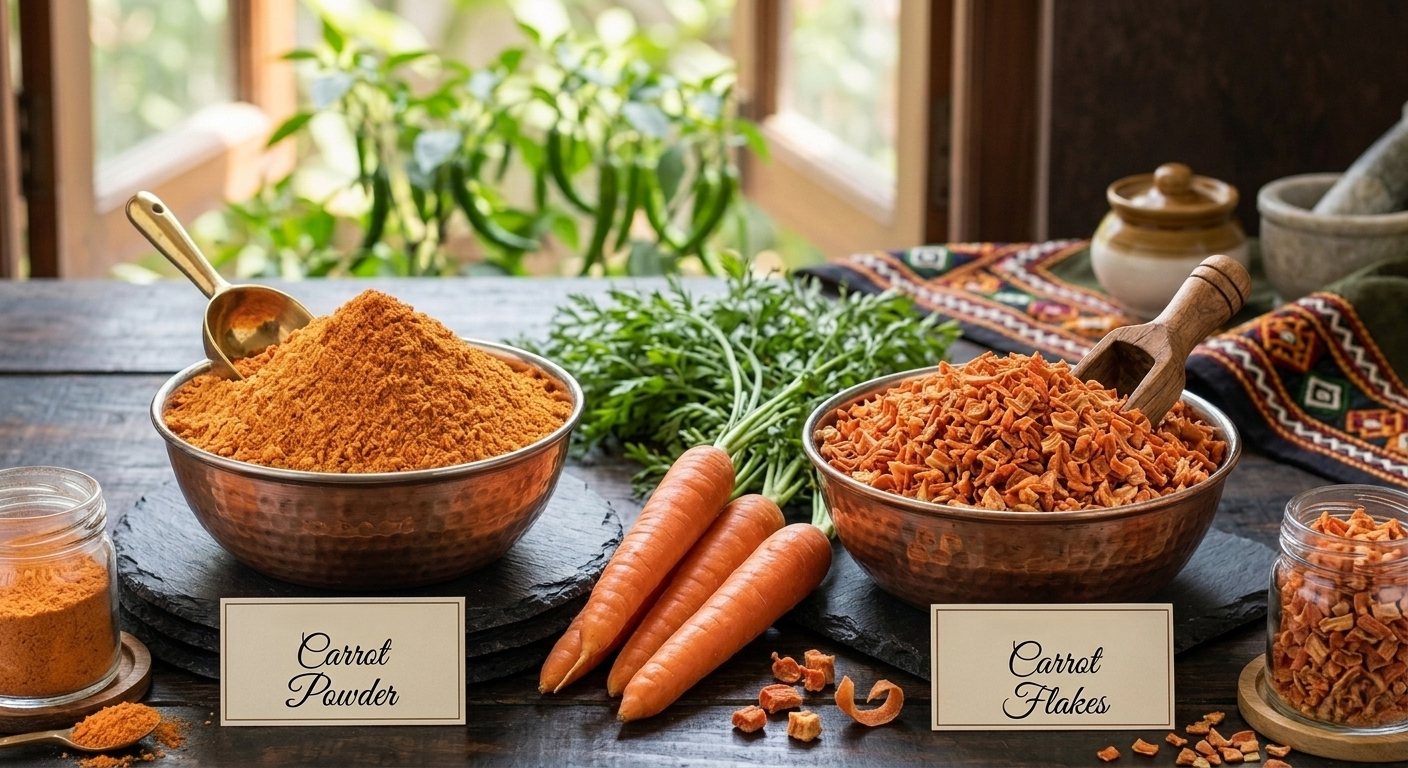 | VEGETABLE, HERBS & SEEDS POWDERS / FLAKES / GRANULES 🥕 Prime Herbonix Carrot Powder / Flakes are produced from carefully selected fresh carrots that are hygienically washed, dehydrated, and processed... View product → |
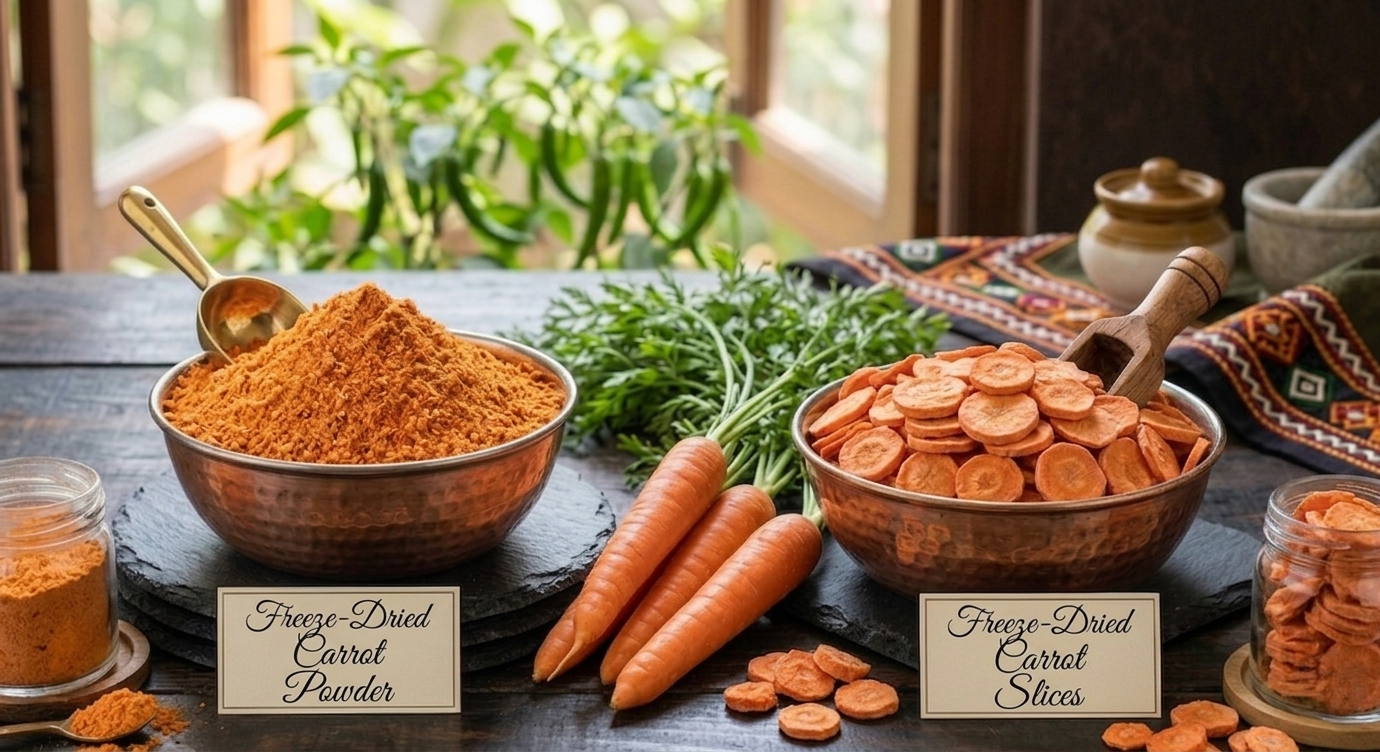 | FREEZE-DRIED VEGETABLE & FRUIT POWDERS /SLICES /CHUNKS FREEZE-DRIED CARROT POWDER / SLICES 🥕 Prime Herbonix Freeze-Dried Carrot Powder / Slices are produced from carefully selected fresh carrots using advanced freeze-drying technology to... View product → |
Use a supplier-approval checklist before committing to a repeat order
A carrot powder supplier in Pune or dehydrated carrot powder supplier should pass documented approval before a repeat order. Collect evidence against the actual recipe, food category, and destination market, not against a vague “100% carrot” claim.
- Record the product name and format; whole-carrot or juice-derived identity; peel and blanching status; drying method; particle-size distribution or flake dimensions; moisture and water activity; bulk density; colour method; and sensory description.
- Request microbiological results, pesticide and heavy-metal testing, sulphur dioxide or other processing-aid declarations, and allergen and cross-contact statements. Ask for test methods, sample dates, and numerical results, not pass/fail claims; match limits to the intended food category and destination market.
- Verify packaging construction, batch traceability to the raw-material lot, manufacturing date, shelf-life basis, current certificate of analysis, and a retained sample for comparison after delivery.
- Keep native carrot powder separate from standardised beta-carotene ingredients. Do not approve it internally as a potency-controlled nutraceutical ingredient without a validated assay, batch results, and regulatory documentation.
Release the supplier as approved only after a successful pilot and complete traceability. Conditionally approve after corrective evidence when documentation is incomplete but the pilot passes; reject after a failed pilot or missing traceability.
Frequently asked questions
Which carrot format suits a manufactured food product?
Use fine carrot powder for seasoning blends, soups, sauces, bakery premixes, pasta, nutrition powders, and dry beverages. Choose flakes or slices when the finished product needs visible carrot pieces, chew, or rehydrated texture.
How should you set a starting inclusion rate for carrot ingredients?
Start with a controlled trial based on the finished recipe, then test colour, flavour, dispersibility, water uptake, texture, and processing performance. Evaluate rehydration in the real product rather than in water alone.
What should a purchase specification for carrot powder or flakes include?
State the format, particle size or flake dimensions, moisture limit, colour requirements, ingredient declaration, microbiological limits, foreign-matter control, packaging, batch traceability, shelf life, and required test documents.
How do conventional dehydrated carrot ingredients compare with freeze-dried formats?
Conventional dehydration usually offers a practical option for cost-sensitive applications and standard food processing. Freeze-dried carrot can preserve colour, aroma, shape, and porous rehydration, but it requires a cost and handling comparison for the finished product.
What should Pune buyers check before placing a repeat order?
Review the supplier's sample consistency, specification sheet, certificate of analysis, food-safety documentation, packaging integrity, storage instructions, lead time, minimum order quantity, transport conditions, and batch complaint process.