
The right butterscotch flavour depends on more than whether a sample tastes buttery and sweet. You need to match the profile, delivery format, processing conditions, dosage, regulatory position and powder-handling properties to the finished product. By the end, you will have a practical method for comparing samples and setting up a controlled prototype trial.
Key takeaways
- Define the finished product, process conditions and permitted label claim first.
- Compare liquid, emulsion, spray-dried and nature-identical flavour options by application.
- Test flavour after heating, mixing, storage and the intended serving conditions.
- Request dosage guidance, powder specifications, batch documents and regulatory declarations.
Start with the product brief, not the flavour name
Define the finished product before you ask for a butterscotch sample. The brief must describe where the flavour will go, what it must taste like after processing, and what label claim the target market permits; “food grade butterscotch flavour” is not a complete specification.
1. Name the application, serving size and base: water, milk, protein drink, dairy dessert, bakery, confectionery, cereal or snack coating. State the batch size and target flavour intensity at consumption, not only at the mixing stage.
2. Describe the sensory target in concrete terms. Request a balance of cooked sugar or caramel, butter, cream and vanilla, then specify whether you want light confectionery butterscotch, dark toasted butterscotch, butter-forward, caramel-forward, or a profile suited to dairy or non-dairy products.
Exclude near-neighbours such as toffee, dulce de leche and vanilla-caramel if they are not acceptable.
3. Record the process: mixing temperature, pasteurisation or baking temperature, shear, homogenisation, acidity, fat level, water activity and storage period. Ask suppliers to evaluate samples in the finished matrix, because a flavour that smells accurate in a vial can become weak, harsh or unstable after heat treatment.
4. State the target market and labelling position. Check whether “natural flavour” is legally usable under the destination rules; in the EU, Regulation 1334/2008 sets source and 95% named-source conditions. In the US, check 21 CFR 101.22 and the flavour’s legal basis rather than copying “natural,” “nature-identical” or “artificial.”
5. Request the carrier, composition or regulatory declaration, allergen statement and intended-use limits. The word “butter” does not prove that milk is present—or absent—so verify it before approving samples.
That is how to choose butterscotch flavour for food products without letting the flavour name decide the formulation.
Compare flavour formats, profiles and regulatory claims
Liquid or powder fits the formulation best according to where you add it and how the product is processed. Compare these butterscotch flavour options before choosing a profile or making a labelling claim.
| Option | What it means | When it fits |
|---|---|---|
| Liquid concentrate | High-impact flavour in a liquid carrier | Syrups, fillings and batters; choose water-dispersible, emulsified or oil-soluble type for the product matrix |
| Spray-dried powder | Flavour held on a dry carrier | Nutrition powders and dry blends; improves handling but adds carrier solids and can delay flavour release |
| Encapsulated powder | Volatile compounds protected for controlled release | Reconstituted drinks or long-storage powders; test mixing, release and flavour intensity |
| Natural | Meets the target market’s defined natural-flavour conditions | Use only after checking source materials and permitted wording |
| Nature-identical | Supplier terminology for a flavour resembling a natural compound | Treat as a technical description, not an automatic label claim |
| Artificial | Flavouring that does not qualify as natural under the applicable rules | Useful for profile consistency, subject to market-specific declaration rules |
A food grade butterscotch flavour is not a complete legal or purchasing specification. For US products, check the 21 CFR 101.22 meaning of “natural flavor” or “artificial flavor,” plus the ingredient’s legal basis, use level and allergen status; a FEMA GRAS number alone does not clear the finished product.
For EU products, verify Regulation 1334/2008, including the 95% source-material rule where a named natural source is claimed.
Before approval, request:
- Carrier or solvent details
- Allergen and regulatory declarations
- Specification and lot documentation
- A sample label statement for the target market
Choose a format that survives beverages and bakery processing
Select the format by process survival, not by flavour description alone. Butterscotch flavour for beverages must match the liquid phase, while butterscotch flavour for bakery products must match the bake and the point of addition.
| Format | Best fit | Main check |
|---|---|---|
| Water-soluble liquid | Clear aqueous drinks | No oil ring, haze, sediment or flavour loss |
| Emulsified liquid | Milk, protein and fortified beverages | Stability with protein, minerals, fat and hydrocolloids |
| Oil-soluble liquid | Fat-rich fillings and coatings | Uniform distribution without separation |
| Spray-dried powder | Nutrition powders and dry mixes | Fast dispersion, low dust and no agglomeration |
| Heat-stable system | Cookies, cakes and baked bars | Flavour intensity after the actual oven cycle |
| Post-bake liquid | Icing, cream and fillings | Bright flavour without thinning or weeping |
Test a beverage in its finished formula, not water alone. Check dispersion after homogenisation or heat treatment, then inspect clarity, phase separation, sediment and flavour uniformity through the planned shelf period. Acidic drinks need a separate trial because low pH can change both stability and flavour release.
For bakery products, compare the flavour before baking and after the real time-temperature cycle. Toasted sugar, cocoa, vanilla and dairy notes can bury volatile butterscotch top notes. Use a heat-stable base for the batter, then test a smaller post-bake addition in icing or filling when a brighter profile is needed.
Split additions only after confirming the combined system’s labelling, allergen and natural or artificial flavour position. Set a bench-dose range for each format; concentration, sweetness, fat, protein, pH and processing loss make one supplier’s use rate unreliable for another.
Adapt the choice to powders, dairy, confectionery and other applications
Run finished-product trials, not water-only sniff tests. The right butterscotch flavour options must survive each matrix’s heat, fat, protein, acidity, mixing and storage conditions.
- Nutrition powders: blend the powder with the complete formula, check segregation after handling, then reconstitute in cold and warm water. Measure flavour after 5, 30 and 60 minutes; minerals, protein and sweeteners can suppress or distort the profile.
- Dairy products: test in the intended milk or yoghurt base after pasteurisation or UHT treatment. Check flavour, emulsion stability, acidity and refrigerated storage; a buttery note that works in milk can turn heavy in an acidic yoghurt.
- Ice cream: evaluate the mix after homogenisation, freezing and hardening. Compare flavour at freezer temperature and during melt, because cold suppresses aroma and fat changes release.
- Confectionery: add the flavour at the actual cooking or depositing stage, then check cooked-sugar character, scorching, fat compatibility and flavour loss.
- Desserts: test baked, custard and chilled formats separately. Record flavour after refrigeration and look for interactions with vanilla, cocoa or caramel.
- Cereals: apply the flavour to the finished coating, then test adhesion, powdering, oxidation and flavour retention during accelerated storage.
- Snack coatings: run a tumble test and taste after the coating has set. Check oil compatibility, abrasion loss and whether salt or spice masks the butterscotch.
Approve the sample only after sensory checks at the intended serving temperature and through the planned shelf-life conditions.
Set dosage, powder specifications and supplier checks before approval
A supplier’s “0.1% use level” is a starting point, not an approval dose. Convert it into a finished-product test range and judge the result after processing, storage, and interaction with cocoa, coffee, minerals, protein, sweetness, fat, and acidity.
1. Calculate the supplier rate against the complete formula, not only the powder phase. Test 0.5×, 1×, and 1.5× the recommendation in identical bench batches. Record flavour intensity, aftertaste, dispersion, colour, and any sedimentation, then repeat the preferred dose after the planned heat treatment or baking step.
2. Lock the prototype dose as grams per kilogram of finished product. State the point of addition, mixing time, process temperature, and target shelf life. A dry food grade butterscotch flavour powder may suit a nutrition powder, while a liquid concentrate may suit a syrup; do not transfer the dose between formats.
- Product specification naming the flavour format, carrier, moisture limit, bulk density, particle-size range, solubility or dispersibility, storage temperature, shelf life, and packaging.
- Representative certificate of analysis with lot number, production date, microbiological limits, and test results.
- Composition or regulatory declaration, allergen statement, and target-market labelling status. “Natural,” “nature-identical,” or “artificial” needs confirmation under the destination market’s rules; “butter” does not prove milk content.
For how to choose butterscotch flavour for food products, compare the approved sample against the specification and retain a sealed reference. Prime Herbonix Health Products Private can be assessed on the same powder performance, document, and lot-release criteria as any other supplier.
Related product
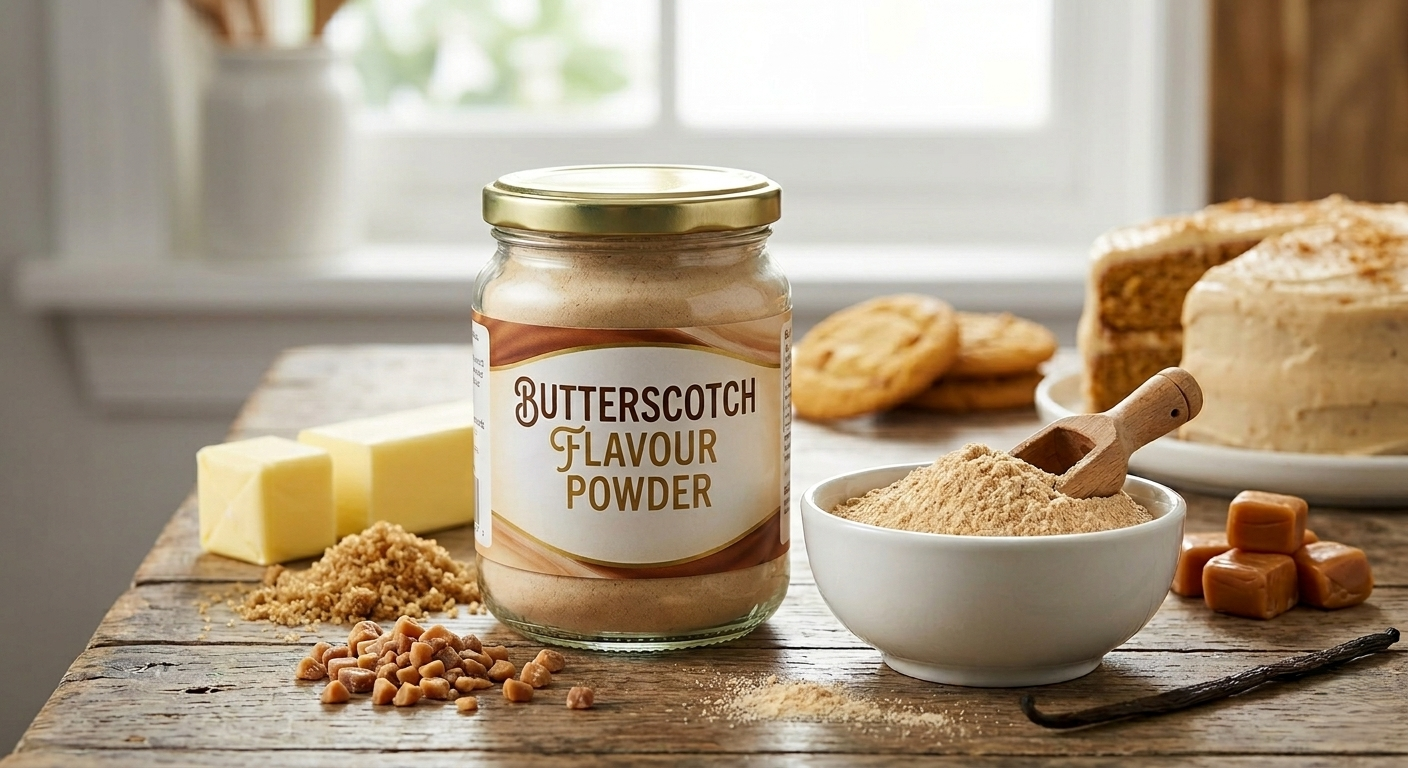 | FLAVOURS Prime Herbonix Butterscotch Flavour Powder is a premium-quality flavoring ingredient developed to deliver the rich, creamy, and buttery taste of... View product → |
Frequently asked questions
How do you choose butterscotch flavour for food products?
Start with the finished product brief: define the target taste, processing conditions, format, dosage range and permitted label claim before requesting samples.
Which butterscotch flavour options suit beverages and bakery products?
Choose a water-dispersible or emulsion format for many beverages, and select a heat-stable liquid or powder format for bakery products after testing it through baking.
What should you check in a food grade butterscotch flavour specification?
Check the ingredient or flavour declaration, carrier, allergen statement, usage limits, storage conditions, batch identification, shelf life and supporting regulatory documents.
How should butterscotch flavour dosage be approved?
Run a controlled trial across a low, target and high dosage, then evaluate flavour after processing, storage and dilution rather than judging the concentrate alone.