
A kilogram of giloy powder cannot be compared with a kilogram of extract as though they were equivalent materials. By checking plant part, extract ratio, marker assay, formulation behaviour, testing and landed cost per serving, you can choose the format that fits your product and approve the right bulk specification.
Key takeaways
- Choose powder for plant matrix, fibre, colour and native taste.
- Match extract strength and solubility to the finished product.
- Treat 10:1 as a ratio, not proof of potency.
- Request identity, safety and batch documents before ordering.
Powder and extract solve different formulation problems
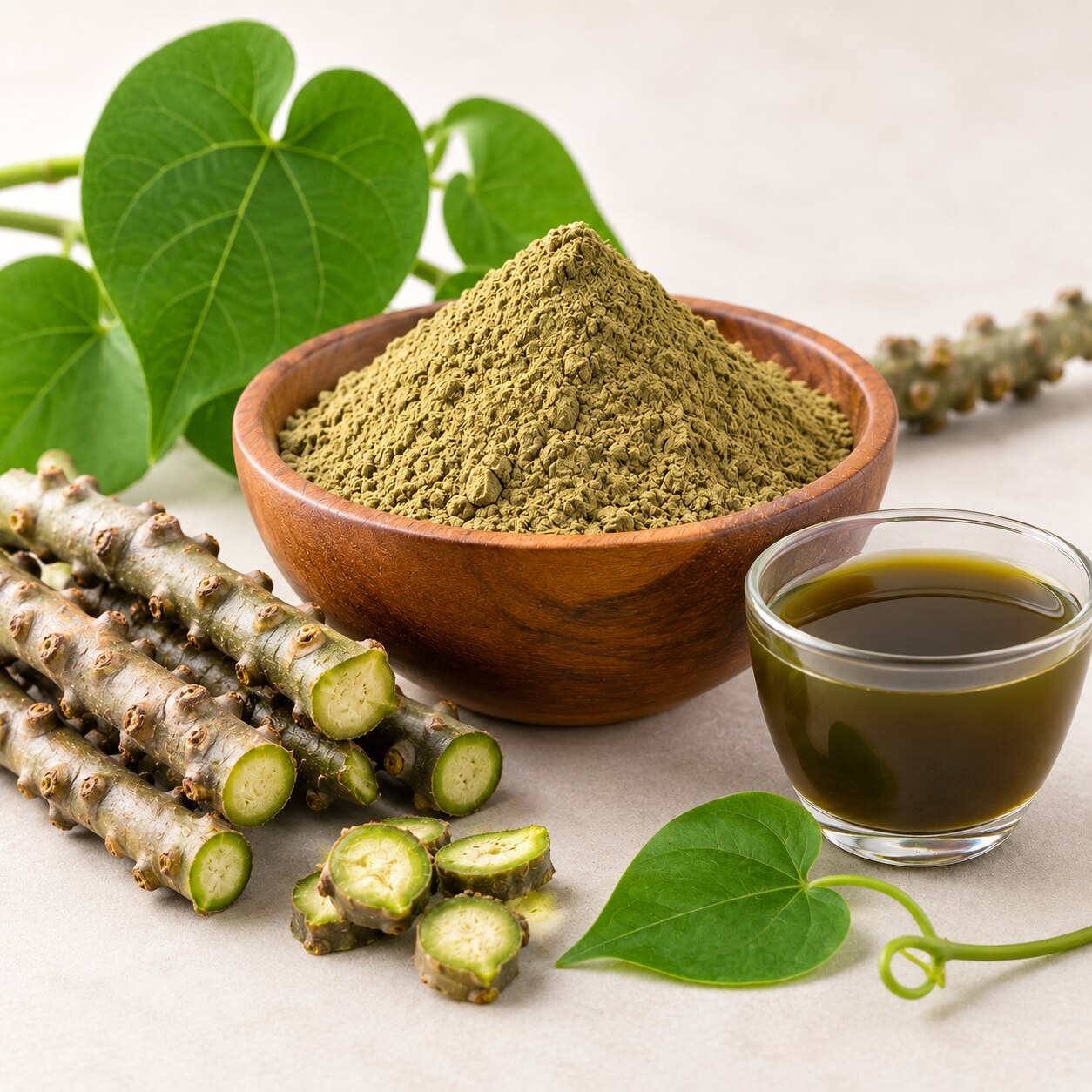
A raw giloy powder is milled Tinospora cordifolia, usually the stem, so it retains the plant matrix, fibre, native constituents, colour and taste. A dry extract is produced by solvent extraction and drying; the solvent and process determine which constituents are removed or concentrated.
A 10:1 ratio describes input plant weight against extract weight, not a guaranteed tenfold level of any marker compound.
| Format | Composition and concentration | Handling |
|---|---|---|
| Powder | Whole milled stem; low concentration per gram; insoluble plant particles | Larger serving, earthy taste, variable flow and microbial load |
| Extract | Selective soluble fraction; concentration depends on solvent and process; may contain a carrier | Smaller serving, better for dispersed formulas, but check hygroscopicity, solubility and uniformity |
For giloy ingredients for nutraceuticals, define the intended product, daily serving and target-market category before approval. A material accepted for an Ayurvedic-drug supply chain is not automatically suitable for a food or dietary supplement; permitted claims, excipient or carrier restrictions, allergen status, irradiation or fumigation status, packaging format and local regulations still apply.
Ask for Tinospora cordifolia, plant part, extraction solvent, native or carrier-based format, carrier identity, moisture limit, marker compound, test method and specification range. Powder needs controls for particle size, foreign matter, pesticides, heavy metals and microbiology; extract also needs solvent-residue, drying-aid and concentration-uniformity results.
Comparing cost per kilogram alone can make a dilute powder appear cheaper than a properly specified extract.
Match the format to the finished product
Use the finished product’s serving size and physical behaviour as the decision rule. Choose powder when the formula can carry the botanical material itself; choose extract when you need a smaller dose, faster dispersion or a stronger sensory and potency profile.
| Format | Choose it for | Why it fits | Main check |
|---|---|---|---|
| Powder | Capsules, tablets, teas, sachets and dry mixes | Provides the milled stem material directly and blends well with other dry ingredients | Particle size, moisture, flow, taste and microbial limits |
| Extract | Beverages, gummies and concentrated formulas | Delivers more material in less space and can disperse more readily after suitable processing | Solubility, colour, bitterness, carrier and stability |
If you buy giloy powder in bulk for capsules or tablets, confirm that the blend can accommodate its volume and compression behaviour. Tea, sachet and nutrition-mix applications suit powder when sediment, colour and herbal taste are acceptable.
Choose extract for a beverage or gummy when a full powder serving would create excessive sediment, a gritty texture or too much botanical flavour. It is also the better fit for concentrated formulas with limited fill weight.
Approve a representative pre-shipment sample against the finished-product brief, not only a catalogue sample. Specify Tinospora cordifolia stem, extraction solvent, native or carrier-based format, extract ratio, marker compound, assay range and moisture limit; a “10:1” label alone does not prove potency.
Compare extracts by tested potency, not by the 10:1 claim
A 10:1 label does not prove tenfold potency. Compare the material by tested marker content, usable solids and cost per finished serving.
| Specification | Extract A | Extract B |
|---|---|---|
| Botanical identity | Tinospora cordifolia stem | Tinospora cordifolia stem |
| Extraction system | Water or named solvent blend | Water or named solvent blend |
| DER | 10:1 genuine extract yield | 4:1 genuine extract yield |
| Carrier | None or stated percentage | Maltodextrin, stated percentage |
| Potency measure | Marker assay with test method | Marker assay with test method |
| Formulation fit | Soluble, defined inclusion | Soluble, defined inclusion |
Ask the supplier whether the ratio describes actual native extraction yield or a formulation ratio created by adding carrier. Request the certificate of analysis for marker-compound assay, moisture, carrier percentage and batch number. A higher DER with a lower assay result can deliver less measurable material per gram.
Calculate the economics in three steps:
- Adjust for carrier: extract solids equal purchase weight multiplied by one minus the carrier fraction.
- Calculate marker delivery: inclusion rate in grams multiplied by assay percentage.
- Calculate cost per serving: price per kilogram multiplied by inclusion grams, divided by 1,000.
Add any required overage and compare cost per defined marker amount, not cost per kilogram. A cheaper extract becomes expensive if its assay requires a larger serving.
For giloy ingredients for nutraceuticals, specify the intended daily serving, permitted claims, colour, taste and solubility before approval. Ask any giloy extract manufacturer in pune for solvent details, standardisation data and a sample matching the production batch.
Set a batch specification for identity and safety
Approve a lot only against a written specification, not a catalogue description. State Tinospora cordifolia and the plant part, normally stem; root, leaf, Tinospora crispa and unidentified “giloy” material are different raw materials.
1. Confirm botanical identity with the accepted scientific name, plant part, voucher or reference-material details, and a batch-specific macroscopic, microscopic, chromatographic or DNA-based result. Reject a lot that cannot distinguish T. cordifolia from T. crispa.
2. Set physical limits for particle size, moisture or loss on drying, foreign matter, colour, odour and, for extracts, solubility or dispersibility. Record the extract ratio, solvent, native or carrier-based format, carrier identity and bulk density where handling depends on them.
3. Require a chemical fingerprint or assay, named marker compounds and standardisation percentage when claimed. Test aflatoxins, heavy metals, pesticide residues and residual solvents when the extraction process makes them relevant; set limits for the destination market and finished product.
4. Specify total aerobic microbial count, yeast and mould, and named pathogens such as Escherichia coli, Salmonella and Staphylococcus aureus. Use the limits in your market’s food or nutraceutical standard, not a copied supplier template.
5. Demand a batch-specific certificate of analysis, supporting reports, lot number, manufacturing date, retest or expiry date, storage conditions, legal manufacturing site and traceability record. A giloy powder bulk supplier in pune should also provide a representative pre-shipment sample, retain-sample policy, out-of-specification procedure and written change notification for species, plant part, solvent, site or carrier.
Qualify the supplier before you place a bulk order
A catalogue listing does not prove that a Pune seller makes the material. Before you buy giloy powder in bulk, establish whether the giloy powder or extract supplier in Pune is the processor, a trader, or a distributor representing another site.
1. Request the legal manufacturing address, applicable FSSAI licence or nutraceutical manufacturing authorisation, and the name of the actual processor. A giloy extract manufacturer in Pune should identify the extraction site, not only its sales office. Ask Prime Herbonix Health Products Private for the same evidence you would request from any candidate supplier.
2. Put the raw material identity in writing: Tinospora cordifolia, stem, powder or extract, and the agreed extraction solvent. Do not accept “giloy” alone; root, leaf, and stem materials are not interchangeable.
3. Trace one finished lot backwards to incoming botanical material, processing date, equipment, test results, packing record, and dispatch record. Review HPTLC or HPLC fingerprint results alongside the certificate of analysis.
4. Approve a representative pre-shipment sample against your specification, not a catalogue sample. Record the lot definition, identity-failure remedy, out-of-specification investigation, retesting rule, retain-sample period, minimum order quantity, lead time, and delivery terms.
5. Add written change control. The supplier must notify you before changing species, plant part, extraction solvent, carrier, manufacturing site, or process. A low price is irrelevant if every repeat shipment requires requalification.
Related products
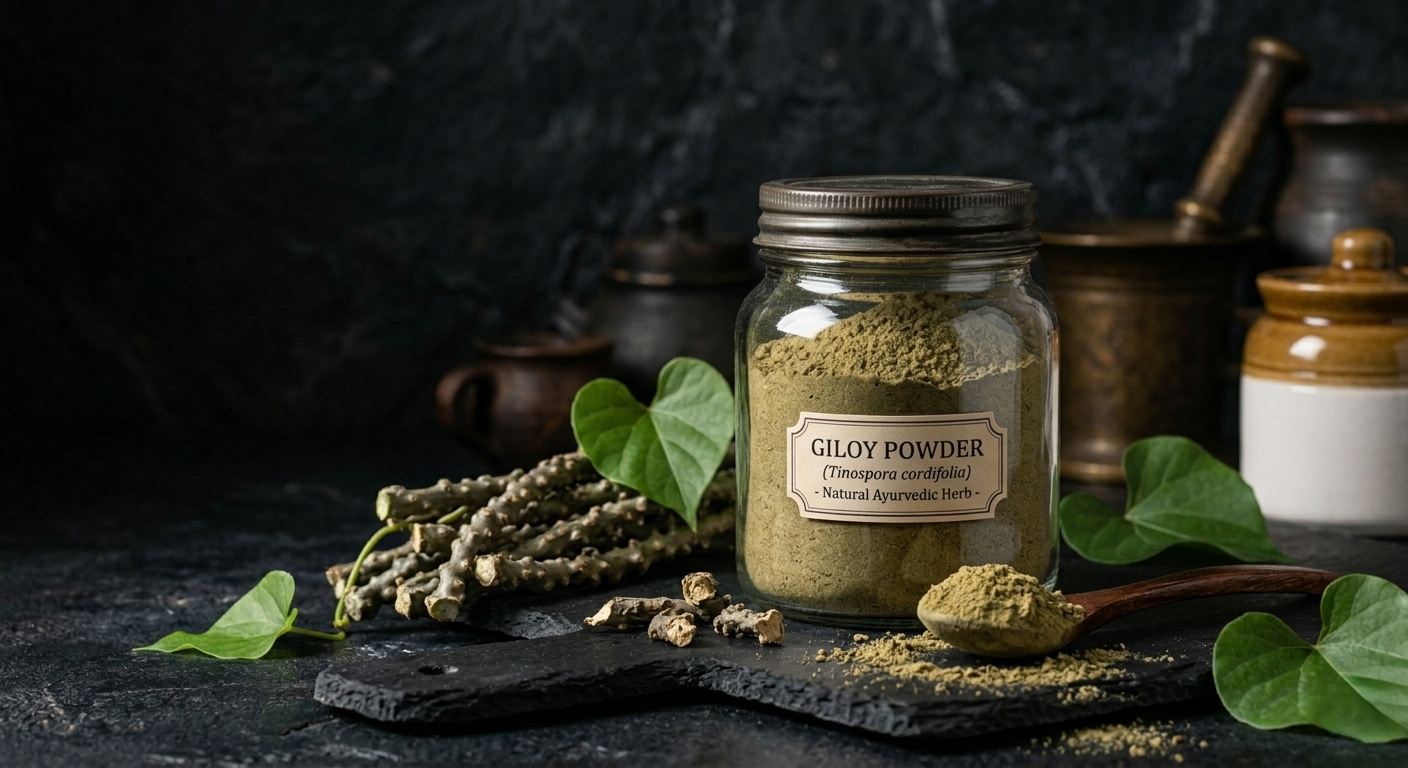 | VEGETABLE, HERBS & SEEDS POWDERS / FLAKES / GRANULES 🌿Prime Herbonix Giloy Powder is produced from carefully selected Giloy (Tinospora cordifolia) stems that are hygienically processed and finely... View product → |
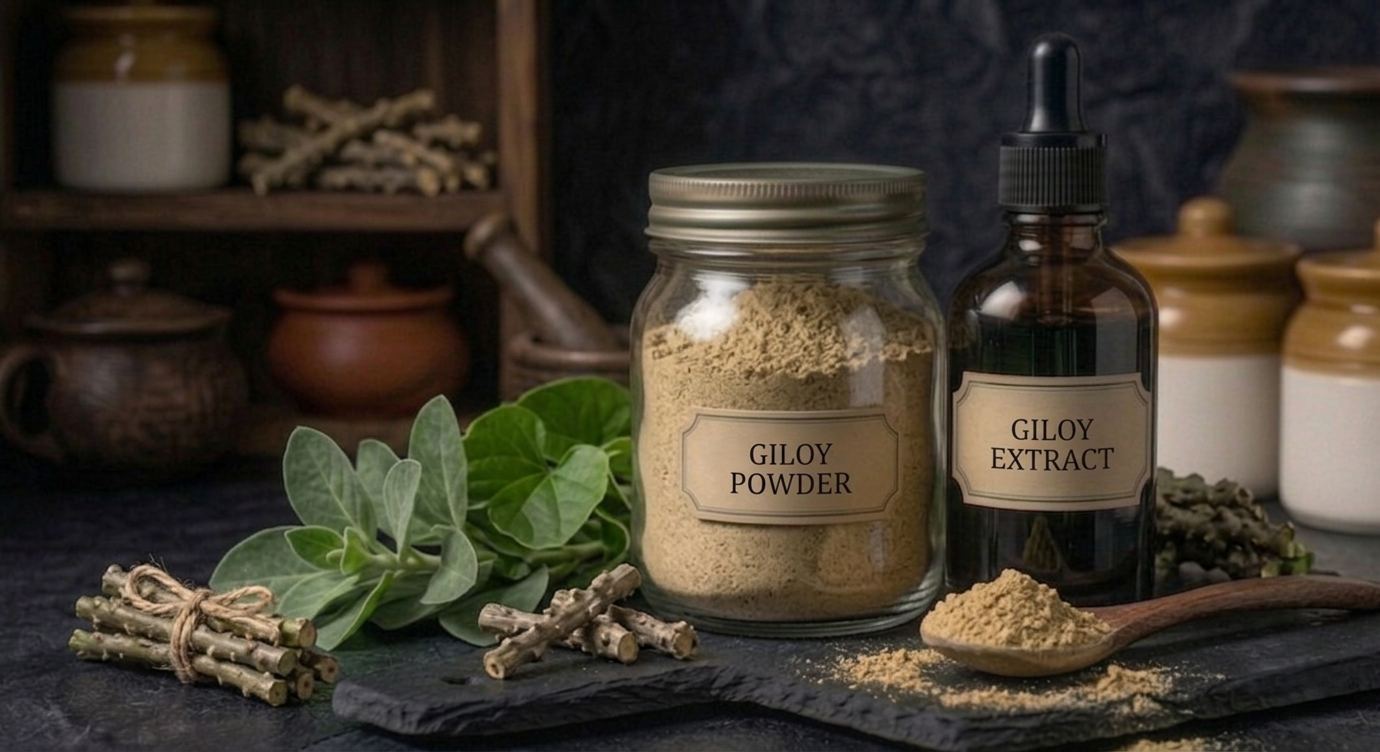 | HERBAL POWDERS & EXTRACTS Prime Herbonix Giloy Powder & Extract are derived from carefully selected Giloy (*Tinospora cordifolia*) stems and processed under stringent quality... View product → |
Frequently asked questions
What is the difference between giloy powder and giloy extract?
Giloy powder is milled Tinospora cordifolia plant material that retains the plant matrix, fibre, native constituents, colour and taste. An extract is processed with a solvent and dried, concentrating constituents selected by that process.
Should you use giloy powder or extract in a finished product?
Choose powder when you want whole-plant material, fibre, natural colour or characteristic taste. Choose extract when you need a more concentrated ingredient, lower inclusion weight or better control over the finished product’s format and sensory profile.
Does a 10:1 giloy extract prove higher potency?
No. A 10:1 claim describes the input-to-output extraction ratio. Compare extracts using test results for identity, marker compounds or other declared potency measures, along with the extraction solvent and batch specification.
What should bulk buyers check before ordering giloy ingredients?
Set specifications for botanical identity, plant part, processing, moisture, microbiological safety, heavy metals, pesticide residues and other required tests. Ask the supplier for representative certificates of analysis, batch traceability and quality documents before placing the order.